AI Twins
An AI twin is the consumer-facing intelligence object in Consumr.AI. A twin is a representative of a cohort, not an individual person.
The #1 thing to internalize: representative, not individual
Section titled “The #1 thing to internalize: representative, not individual”Ethan Mitchell, a 41-year-old managing director in New York, is not a real person; he is the personified center of a behavioral distribution. The underlying report may cover a 25–54 age range with a 51/48 male/female split. Ethan’s demographic details are the median expression of that cohort, not a profile of one user.
The first objection clients raise, “why is this person not like my actual customer?”, misunderstands the model. The twin answers on behalf of the masses within the cohort, not on behalf of any individual outlier. If you want to understand the niche, you define a narrower segment; the twin will still represent the masses within that niche, not an individual case.
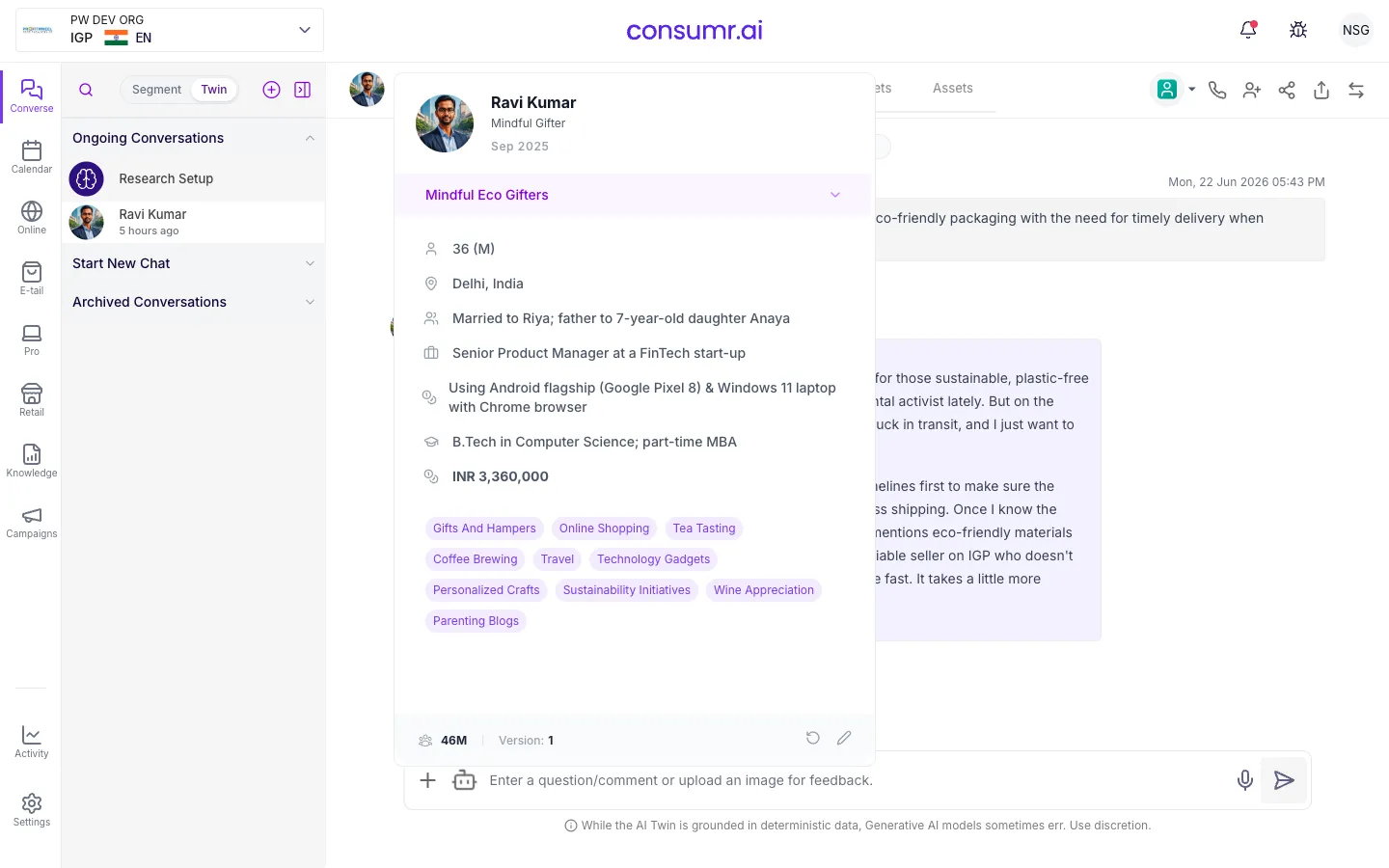
Anatomy of a twin
Section titled “Anatomy of a twin”graph TD
BR[Behavior Report<br/>persona] --> TW[AI Twin]
IR[Intent Report<br/>memory: what they want] --> TW
MR[Mentions Report<br/>memory: what they say] --> TW
TW --> MM[Mindset Metrics]
TW --> RM[Reasoning Modes]
TW --> QR[Questioner Roles]
TW --> ME[Memory]
Three reports assemble into one twin. The twin is shaped by mindset metrics, responds through reasoning modes, interprets questions through the questioner role, and carries memory across sessions.
Mindset metrics
Section titled “Mindset metrics”When you create or tune a twin, you set mindset metrics: six dials that control how the twin relates to the brand and category:
- Brand attachment: how loyal this person is to the brand
- Emotional affinity: how emotionally invested they are in the category
- Purchase intent: how actively they are considering a purchase
- Category awareness: how much they know about the category overall
- Familiarity: how much experience they have with the product
- Skepticism: how cautious or doubtful they are
These metrics replace the earlier “stages of conversion” model. They are tunable and should reflect what the segment definition says about these people.
Tuning examples. A loyal GEICO customer who has never considered switching: brand attachment at 100%. A churned prospect who is actively shopping competitors: brand attachment at 5–10%, purchase intent high. A Gen Z renter entering auto insurance for the first time: brand attachment low, category awareness moderate-to-high (they’re searching), skepticism moderate (they’ll switch if a better rate appears).
The metrics are not decorative; they shape how the twin responds to questions about brand preference, switching behavior, and messaging resonance.
Reasoning modes
Section titled “Reasoning modes”Each twin can respond in three reasoning modes, selectable during a conversation:
Practical (rational). The twin gives the considered, analytical answer, the one they’d give if asked to justify their decision with logic. For the American Express Platinum card example: “The $695 annual fee is already offset. I’ve done the math: lounge access, statement credits, the net cost is minimal.” This is the socially acceptable, rational story.
Emotional. The twin drops the facade and gives the honest motivational truth. The same Amex twin in emotional mode: “I have a deep-seated need to feel like I’m winning the system. The spreadsheet is a security blanket. When I put that card on the table, I want it to make a sound.” The ego hit, the status signal. The real reason. Amex’s metal card with its distinct weight and click was designed for exactly this need.
Reflection (self-introspection). The twin examines its own response: why it said what it said, what the response reveals about its underlying values and contradictions. In reflection mode, the twin might note the gap between the practical justification it gave and the emotional truth underneath.
Questioner roles
Section titled “Questioner roles”Who is asking the question matters as much as who is answering it.
Ask as me (brand representative). When you operate inside a portfolio, say, an American Express portfolio, the twin knows you represent the brand. It will contextualize every answer relative to American Express. Ask “would you consider us?” and you’ll get an in-category, brand-aware response.
Ask as a category researcher (neutral). A neutral researcher doesn’t introduce their affiliation. The twin is told only “someone is conducting a survey on credit cards”: no brand context. This produces unbiased answers that reveal how the cohort thinks about the category, not just the brand. The difference between these two modes can surface critical insight: what a person says to a neutral researcher versus a brand representative is often not the same.
Auto-update toggle
Section titled “Auto-update toggle”Twins can be set to auto-update: a monthly rerun of all three underlying reports. When a twin updates, its demographic center may shift if the cohort’s composition has changed. If the American Express core audience moves from predominantly male to more mixed over 12 months, Ethan Mitchell’s profile will reflect that shift; his characteristics update to match the new cohort reality. The name may stay the same; the person may change.
Feedback, trace, and shareable cards
Section titled “Feedback, trace, and shareable cards”- Feedback (thumbs up/down): Marking a response as good or bad feeds the model. Positive feedback reinforces that type of response; negative feedback teaches the model to avoid that pattern.
- Trace: Every response can show a data provenance trail: which report data supported which claim. This is the auditability layer.
- Shareable visual card: Long conversation responses can be condensed into a visual card format that is shareable with stakeholders who don’t want to read a full conversation log.
Memory and multi-twin meetings
Section titled “Memory and multi-twin meetings”Twins accumulate memory across every research session they participate in. This memory is portfolio-scoped: the twin carries a summary of every focus group, interview, and research study it has joined within that portfolio.
When a conversation calls for a different perspective, you can invite another twin into the session. That twin joins with its own memory intact; it knows what it has discussed in previous research, but it enters the current meeting fresh to the current conversation. This mirrors how a real meeting works: you bring in a colleague who has context but hasn’t been in this room before.
Memory that is no longer relevant is pruned automatically.
Recency: the 21-day rule
Section titled “Recency: the 21-day rule”Twins are built from cohorts of people active in the last 21 days. This is not a configurable setting; it is the platform’s definition of “current.” It means twin responses reflect contemporaneous behavior, not patterns from six months ago. For rapidly shifting categories (insurance pricing, consumer tech sentiment), this recency is a significant advantage over traditional research timelines.